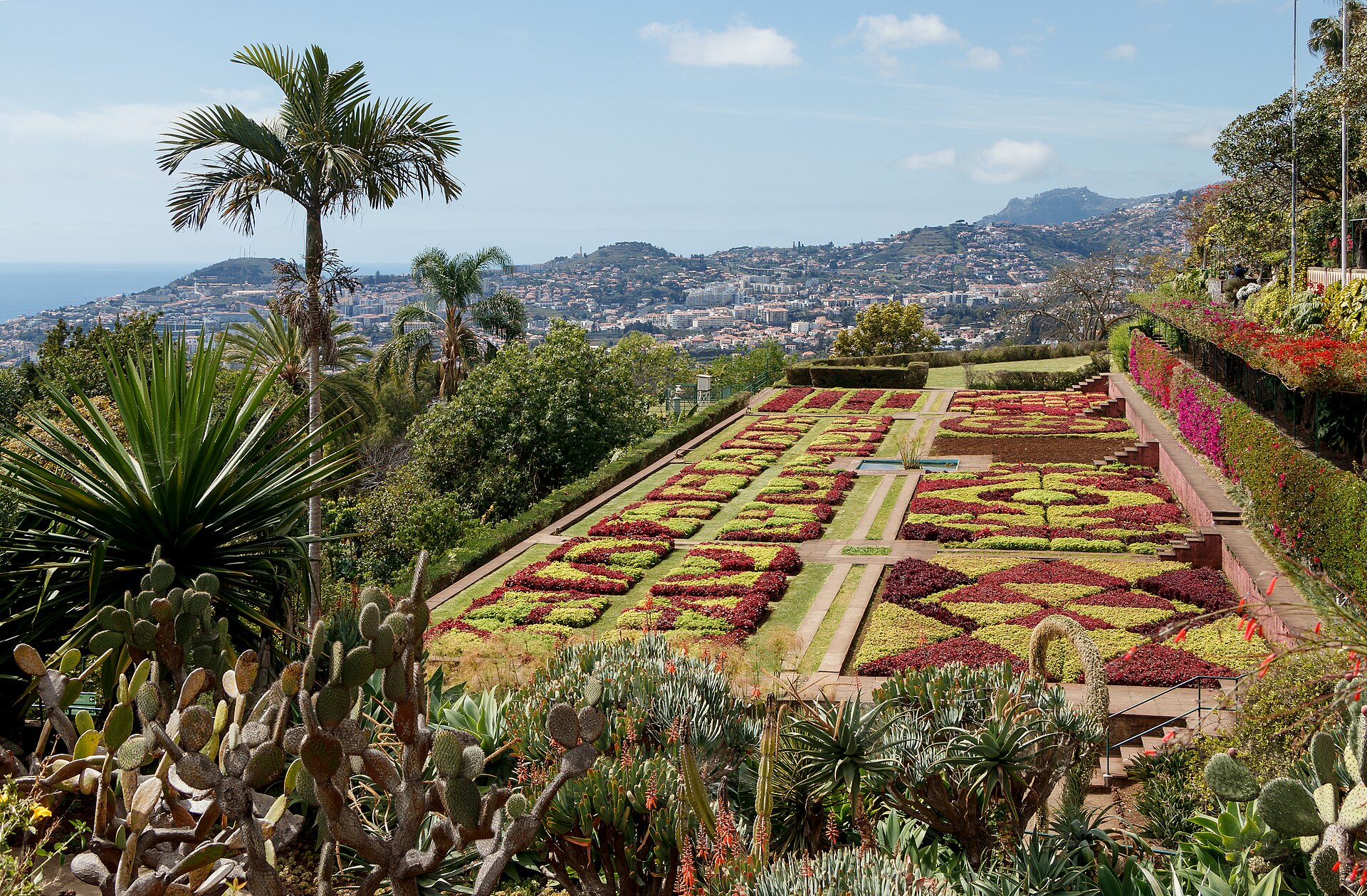
The flower beds at the Madeira Botanical Garden look like a rug someone rolled out across the hillside, clipped into tight geometric patterns. Behind them, the whole of Funchal drops away to the sea.
The garden sits on the old Quinta do Bom Sucesso estate, about 3 km above the city centre. Scientists work here. Most visitors, though, come for the colours and that view.
This page is for you if you like plants or just want a calm half day away from the seafront. Planning Monte too? A cable car links the two.
Madeira Botanical Garden at a glance
- Full name: Jardim Botânico da Madeira Eng.º Rui Vieira, named after the engineer who founded it and was its first director.
- Where: Caminho do Meio, on the slopes above Funchal, between roughly 150 and 300 metres of altitude.
- Size: about 8 hectares, 5 of them planted as gardens.
- Opening hours: open daily, 9:00 to 18:00, closed on 25 December (at the time of writing, October 2026).
- Tickets: paid for non-residents, free for residents of Madeira since 1 January 2026.
- Time needed: we’d keep a relaxed half morning for it, more if you add the museum.
- Bring: comfortable shoes for the slopes and a light jacket, since it is cooler up here than on the seafront.
A short history
The idea of a botanical garden for Madeira is old. A document from May 1798 already raised it, and several naturalists pushed for one during the 19th century.
It finally happened in the 20th century. In the early 1950s the regional authority bought the Quinta do Bom Sucesso, an estate the Reid family had created in 1881 (the same family behind Reid’s Hotel). The garden opened to the public on 30 April 1960.
In 2009 it took the name of Rui Vieira. Today it still studies the flora of Macaronesia, the group of Atlantic islands that includes Madeira, the Canaries and the Azores.
What to see in the garden
The garden holds more than 2,500 plants from every continent, including around 200 species native to the region. It is laid out in six areas.
The carpet flower beds
These are the postcard. Low, clipped plants form mosaic patterns on a sloping lawn, and the beds are replanted regularly as the plants age.
For the classic photo, stand above the beds so the patterns and the city below fit in the same frame. Honestly, go early if you want it without other people in the shot.
Indigenous and endemic plants
Plant lovers, start here. This section gathers species that grow only in Madeira or in the wider Macaronesia region.
Look for Geranium maderense, a large endemic geranium with purple flowers, and Musschia aurea, a rare endemic with yellow flowers. Every plant in the garden carries a label with its scientific name, common name, family and origin, so you don’t need to be a botanist to follow along.
Succulents and cacti
The succulent area sits in the centre and east of the garden. Big cacti and spiny prickly pears stand together on the dry slope, and it is one of the most photogenic corners.
The arboretum, palms and useful plants
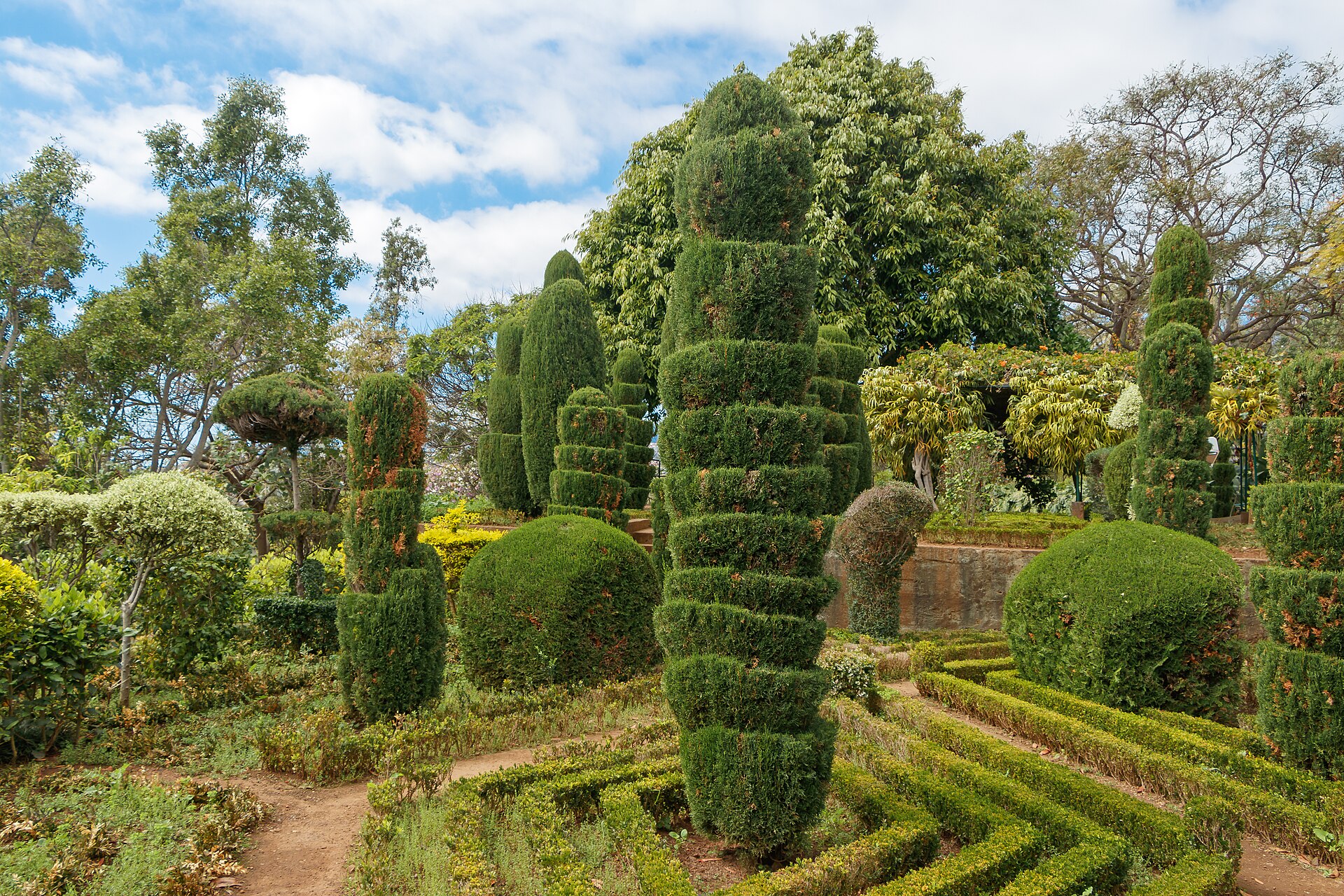
The arboretum fills the northern part, with trees and shrubs from around the world. The palms and cycads are in the south.
Between them you’ll find the agro-industrial plants (crops grown for food or industry) and a section of medicinal and aromatic herbs. Strelitzias, the orange bird-shaped flowers you see all over Madeira, flower here all year.
Louro Parque, the bird park
At the southern end, the Louro Parque aviary keeps around 300 exotic birds, with macaws, cockatoos, parrots and lories, many of them from South America.
Entry is included in the garden ticket. No feeding, though.
The Natural History Museum
A small museum with three rooms shows rocks, fossils, minerals, insects and preserved animals. It won’t take long. But on a showery day it is a good place to wait for the sun.
The lovers’ cave and the viewpoint
Inside the garden you’ll find the lovers’ cave, lined with ferns and fitted with a table and chairs made of volcanic pebbles. Nearby, the garden’s viewpoint looks over the city’s amphitheatre, with the sea on one side and the mountains on the other.
The Via Rápida expressway runs right under the garden and shows in the view. Ignore it. The view still wins.
Tickets and prices
Ticket prices are set by the IFCN, the regional forest and nature conservation institute that manages the garden. In 2025 everyone paid €10. Since 1 January 2026 residents of Madeira enter free, while non-residents still pay.
Garden only? Check the 2026 non-resident rate at the gate or on the IFCN site (October 2026).
The easiest way to pay is often the combined ticket sold by the cable car company, which includes the garden entrance. Prices at the time of writing (October 2026):
| Ticket | Adult | Child (7 to 14) |
|---|---|---|
| Cable car only, one way | €11 | €6 |
| Cable car only, round trip | €16 | €9 |
| Cable car plus garden, one way | €19 | €9 |
| Cable car plus garden, round trip | €24 | €12 |
Children under 7 ride free.
At the time of writing, booking online on the cable car website gave a 10% discount, and tickets stay valid for 12 months. Prices change, so confirm them on telefericojardimbotanico.com and on the IFCN website before you go.
How to get to the Madeira Botanical Garden
By cable car from Monte
This is the fun way. The Teleférico do Jardim Botânico runs between Largo das Babosas in Monte and a station just above the garden, crossing the green valley of the Ribeira de João Gomes.
The line is 1,603 metres long and has been running since 2005. A one-way ride takes between 7 and 15 minutes depending on the speed, and at the highest point the cabins hang 115 metres above the ground.
At the time of writing (October 2026), it runs every day, starting at 9:00, with last boarding at 16:50, and closes on 25 December. The garden itself stays open until 18:00.
Monte itself is reached on the main Funchal cable car, which leaves the seafront. So the classic loop is the seafront cable car up to Monte, the Botanical Garden cable car across the valley, then a bus or taxi back down.
By bus
City bus line 31 serves the Jardim Botânico stop, with departures from the centre near the Cais and the Palácio de São Lourenço. Gaps between buses vary a lot, and the timetable differs on weekdays, Saturdays and Sundays. Check line 31 on the Horários do Funchal or SIGA (siga.madeira.gov.pt) websites.
By car or taxi
Head toward Monte first. Signs for the Jardim Botânico take over from there. The roads up here are steep and winding, so take it slowly.
A taxi from the seafront is the easy option if you’re short on time.
By tour
Plenty of half-day tours from Funchal combine the Botanical Garden with Monte, often including the toboggan ride down. Tuk-tuk tours also run up here from the centre.
Botanical Garden or Monte Palace?
People often ask which garden to choose. They are very different.
The Botanical Garden is the scientific one, with labelled collections, endemic plants, the carpet beds and a wide view of the city. The Monte Palace Tropical Garden is a private estate with oriental gardens, lakes and tile panels, and it feels more like walking through a stage set.
If you can, do both in one day. The cable car between Monte and the Botanical Garden makes that easy, and you can finish with the toboggan.
Where to stay
No need to sleep next to the garden. Stay in central Funchal instead, where the buses and the main cable car are close by.
Our general advice is to pick a place 8 to 10 minutes on foot from the seafront. Simple rule. You stay close to everything without paying for the front row, and the bus to the garden leaves from the centre.
Live prices from Booking.com and other sites. Move the map or change the dates to compare.
Want to compare areas? Our where to stay map sets the main bases on the island side by side.
Practical tips and mistakes to avoid
- Go on a clear day. The garden is high above the city, and in bad weather it gets cold and damp, which spoils the view.
- Start early. The light on the carpet beds is softer, and you’ll beat the tour groups.
- Watch the cable car times. The last boarding is at 16:50, while the garden closes at 18:00. Miss it? Bus or taxi.
- Grab a map at the entrance. The paths climb and split more than you’d expect, and more maps stand at key points along the way.
- Wear real shoes. Many paths are sloped, although ramps now help with access in parts of the garden.
Want a swim after the garden? Head west to the São Martinho pools, still in Funchal, or out to the north coast at Porto Moniz. Our free Madeira 7-day plan does the sorting for you. Grab it, and save the first clear morning of your stay for the Botanical Garden and its view over Funchal.
FAQ
How much does the Madeira Botanical Garden cost?
In 2025 the ticket was €10 for everyone. Since 1 January 2026 residents of Madeira enter free and non-residents still pay. At the time of writing (October 2026), a combined cable car and garden ticket costs €19 one way or €24 return per adult. Garden alone? Ask at the gate or check the IFCN site.
What are the Botanical Garden opening hours?
At the time of writing (October 2026), the garden opens every day at 9:00 and closes at 18:00, except on 25 December. The cable car stops earlier, with last boarding at 16:50.
How long do you need at the Botanical Garden?
In our view, most of a morning is comfortable. Add more time if you want to see the museum or combine it with Monte on the same day.
Is there a cable car between Monte and the Botanical Garden?
Yes. The Teleférico do Jardim Botânico links Largo das Babosas in Monte with the garden in 7 to 15 minutes one way, depending on the speed. It crosses the valley of the Ribeira de João Gomes.
Which bus goes to the Madeira Botanical Garden?
City bus line 31 stops at the Jardim Botânico. Departures are irregular and change by day of the week, so check the current timetable before you go.
Sources
- Botanical Garden Viewpoint (Visit Madeira)
- Botanical Garden (Visit Funchal)
- Teleférico do Jardim Botânico (Visit Madeira)
- Trips and Prices (Teleférico do Jardim Botânico)
- Technical Features (Teleférico do Jardim Botânico)
- Residents to Enjoy Free Access to Botanical Garden (Times of Madeira)
- Entrada no Jardim Botânico da Madeira gratuita para residentes a partir de 2026 (DNoticias)
- Jardim Botânico da Madeira (Wikipedia PT)
- Madeira Botanical Garden (Wikipedia)
- Le jardin botanique de Madère (Lonely Planet)
- Madeira Botanical Garden (Atlas Obscura)
- Linha 31 Jardim Botânico timetable (SIGA, Governo Regional da Madeira)
- Madeiran Botanical Garden (et al.)
- Renovated Botanical Garden (Madeira Web)
This guide contains affiliate links. If you book through them, we may earn a commission at no extra cost to you (disclosure).